Showing posts with label anxiety. Show all posts

Friday, October 19, 2012

A Coin Toss: Determined Randomness


Flipping a coin.  The most random of acts, used to settle disputes or choose between options.  The outcome is purely arbitrary.  The odds of landing heads or tails are even. Most noticeably, it is a mainstay in sports, football in particular – from the backyard Nerf game to the multimillion dollar NFL industry, we call it in the air to determine who will kick off and who will receive.

Outside the outcome of the game itself, the coin toss is the most wagered on aspect of the Superbowl.  Curiously, it had been won by the NFC for fourteen years straight leading up to the most recent Superbowl.  Even so, the odds in Vegas were even for heads or tails.  No matter how often the result has been the same, the chances remain 50 – 50 each time the coin is flipped.  The streak was broken and the AFC won the toss this past year.

Papa John’s pizza, the official pizza of the NFL, opted not to advertise during the Superbowl.  Instead, they poured their marketing budget into the coin toss.  If the toss came up heads, all of their rewards members would receive a free large pizza and two liter of Pepsi.  It did, and Papa John’s gave away millions of pies.  They also added scores of people to their rewards program, an invaluable source of targeted contact information.  Heads or tails, they won.

All of this – the decision of who will kick off, the Vegas line, and the Papa John’s pizza promotion - is tied to the randomness of the result.  The intrigue comes from this being a model of perfect chance.  Half the time it will end up heads, half the time tails.  There is no discernible pattern and no way to predict what the outcome will be.  You call a side and have a 50-50 chance of being right.

But really, the coin toss is not as random as we may think.  It is, instead, a matter of physics.  A flipping coin must obey established laws. Three primary variables are influencing the outcome – the rate of rotation, the amount of time the coin is in the air, and the amount of change in the axis of rotation.  Though complex in the computation, there is a formula at work with a mathematical solution. Control the variables and you can predict the outcome of the coin toss.

Persi Diaconis, a statistician at Harvard, did just that.  He built a coin flipper, a device that allowed a coin to be flipped repeatedly with the same conditions.  No matter how often it was tossed, the result was the same.  Diaconis could guarantee a heads or tails outcome.  From the moment of the toss, he knew how the coin would land.

The randomness is not in the flipping coin.  It is introduced by erratic humans. The coin flip is predictable, the coin flipper is not.  We flip the coin with varied force at different heights and different angles and catch it in the air at different moments.  The physics formula for flipping coins still holds, but it is impossible for us measure all those variables of speed and force and height in the moment that the coin is airborne.  From our perspective, the result is random.

But what if we could measure all those variables in that moment when the coin is spinning?  What if the formula was as simple as 2+2 and we could do it in our heads?  The coin flip would become far less useful as a random determinant.  We would know the outcome before the coin landed.  It would be determined from the moment the coin was launched.  In this there is a lesson of providence.

They posted a new position at work - a convenience store district manager.  Currently, I manage the company’s highest volume store.  There is no room for growth for me as a single store manager.  I’m at the top of that ladder.  A district manager is the next significant step in my career development. I meet all the qualifications they are looking for.  I sent my resume in.  Now I wait.

For all my qualifications, I would be foolish to think that I am the only potential candidate.  There are other high volume stores with equally competent managers.  I know I am on the short list (someone in the know let that slip).  I also know that, even if short, it is a list.  There are other qualified people who want this job.  I suspect there may be three or four of us vying for the position. 

It feels wholly uncertain to me.  I know I have a chance.  Maybe as good as 50-50.  Maybe less so.  I watch the coin flipping through the air waiting to see if it comes up heads.  Random?  Not quite.  The result of the coin toss is determined from the moment it leaves the hand.  The formula is too complex for me to figure out.  But the one who tossed the coin knew the outcome from the moment it was launched.

I believe in world that is under the control of a sovereign God.  He knows the formula and can do the computation.   He flipped the coin for an intended result.  While I wait anxiously for the outcome, God has already settled it.  Whether I will get the job or not will come as no surprise to him.  He flipped it that way.  This is determined randomness.  What from my vantage point is an arbitrary flip of a coin is from God’s viewpoint a settled physics equation.

I hope to get the job. But even more so I want to trust the coin flipper.  He knows what best.  This is not a coin toss in isolation.  There are countless concurrent coin tosses that are determining the direction of my life.  I see the one coin spinning, he see the myriad…and promises that the outcome of  them all will work out for my good.  Even if this one ends up tails.  Heads I win.  Tails I win.  But when I call it in the air, I’m still picking heads.

Wednesday, June 27, 2012

A Speeding Pilgrimage


I don’t always plod; sometimes I speed.  More careless than reckless, I am easily distracted.  My speed hovers somewhere between “heavy footed” and  “clueless.”

I was reminded of this last Tuesday.

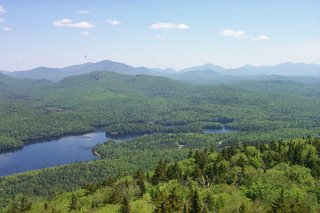
The view from Goodnow Mountain
I took a vacation day to go hiking - called a friend and made ambitious plans to climb four fire towers in the Adirondacks.  We started early, leaving my house at 5:30 and arriving at the first trailhead by 8 o’clock.  We spent the morning summitting Vanderwhacker and Goodnow mountains.  Moderately difficult hiking, cool weather, good company, and stunning views made for a wonderful morning. 

The clock was creeping into early afternoon as we drove toward Long Lake for our third destination – Mount Arab.  Having been tailgated and passed by two vehicles on the way, I was self-conscious of holding up traffic.  I pushed the speed a bit and gave my attention to conversation with my hiking partner.  This was a mistake.  My mind never got the dual core processor upgrade.   I am a poor multi-tasker.  My wife will vouch for the fact that I can’t run two programs simultaneously.  As soon as I open the conversation program, the speed-monitoring program grinds to a halt.   The next time I looked at my speedometer, I was passing a slowing police vehicle traveling the opposite direction.  The needle was hovering around 70 – fine for the Interstate, but not good for a backcountry highway with a limit of 55.  I was low hanging fruit for this officer. 

Fifteen minutes later, the officer told me to watch my speed and to be careful pulling out.  I drove off…ticket in my hand and frustration in my heart.  “Kind of ruins the day,” my friend noted.  “Yeah, it does,” I sighed.  Then I sunk into a sullen silence, providing ample space for the rush of thoughts that followed.

     How could I have been so stupid? 
     Why do I never get off with just a warning?
     Where am I going to get the money for this?
     How many points will this be on my license?
     How long ago was that last ticket?
     Should I drive out for my court date or just send in a guilty plea?
     What will I tell to Sue?
     How could he have missed the two guys that passed me fifteen minutes earlier?
     Why can’t I learn to use cruise control?

I was angry, ashamed, and frustrated; feelings that lingered throughout our third hike.  A pity party on Mount Arab.  I was still picking confetti out of my hair when we reached the fourth fire tower of the day, Cathedral Rock.  The short hike brought us to a pavilion just before the summit.  Beside the pavilion was a large stone with a plaque.  I wish, now, that I had written down the inscription.  Instead, I can only offer a summary.  It was placed by a family as a memorial to their eleven year old son who fell to his death off a nearby cliff in 1996.

I have four children, including a son the same age as the boy who fell to his death.  I can’t imagine what it would be like to begin the day hiking with my family and to end the day mourning the death of my son.  My day of hiking was ruined by a speeding ticket; their day of hiking was ruined by the death of a son.   This brought perspective, a corrective lens for my spiritual myopia.

My sullen reaction to my speeding ticket highlights my aggrandized view of self.  The universe is crafted; the orbit is set; all things revolve around me.   But on Cathedral Rock I got a glimpse of a bigger universe, a grander story, a more complex narrative.  I am not the only character in this play; not even the star of the show.  I’m hung up on court dates and traffic fines while others are planning funerals.    I’m ashamed at the pettiness of my troubles and disappointed that something so small could put me in such a funk.

And this is why God charted this course, from the speeding journey toward Long Lake to the panting stillness on Cathedral Rock:  This was a journey not measured in miles.  God was guiding me from selfishness to self-awareness.  My troubles, because they are mine, loom large in my field of vision.  Everything from speeding tickets to allergy symptoms, from a restless night, to a stressful day, these take center stage in my drama.  But from any other vantage point, these are really quite small.  Reading this memorial, my speeding ticket shrunk in magnitude.  I needed this. God knew.

I’ll be traveling out to Long Lake again soon.  I have a court date set.  Maybe on this trip God will teach me a lesson about mercy.  Or maybe justice.  But this time I’ll be traveling with a new perspective…and I’ll be setting the cruise control.

Blog News:  With warmer weather and summer vacation I am writing less.  This piece in nearly three weeks old.  It just took a while to finish.  It's hard to sit at a computer when the sun is shining.  Plus, opportunities to write for other outlets are growing.  Those pieces often appear on the blog in one format or another, but require further editing (for length and polish) before submission.  So through the summer I'll probably only post every couple weeks.  This is by design.  I'll get back to weekly posts in the fall.   Thanks, as always, for you encouragement and support.

Thursday, May 24, 2012

Faith's Bitter Foe


This post is longer that usual.  It is a copy of an article I wrote in the current issue of Weavings Journal. Unfortunately, the article is not available online on their website - so I make it available to you here. 

            I am a fearful person.  Not in the sense of phobic, though I am a bit wary of heights.  This is fear as anxiety.  I worry.  I worry that my bills will outlast my paycheck, that my children will be enticed down the broad path, that the unfamiliar tightness in my abdomen could be more than just a curiosity, that my wife seems irritated with me.  I worry that I’ve squandered opportunities, that I’ve missed God’s blessing, that I’m wasting my life.  In fact, I worry about most anything that appears to threaten my security or well-being.   I worry much like Abraham.  Despite his credential as “the man of faith” (Galatians 3:9) and his leading roll in the cast of characters who model faith in Hebrews 11, Abraham is not immune from the struggle between faith and fear.  He wrestles with anxiety over issues much like me.
THE BATTLE BETWEEN FAITH AND FEAR
Fear is stalking Abraham at every turn.  When he's told to leave Haran (Gen. 12:1), it's fear that would hold him back; he is stepping into the unknown and leaving behind the safety and security of life as he knew it. When he arrives in the land and finds it occupied (12:6), we can imagine fear raising questions of whether this major uprooting has been in vain.  When he travels to Egypt (12:10-13), fear looks over his shoulder, and capitalizes on a vulnerable moment. He fears for his life and lies about his wife’s identity. When he reflects on his wife's barrenness (Gen. 15:2) he fears that his inheritance will go to his servant Eliezer of Damascus.  The subtle outline of fear is recognizable in each scene.
But when God chooses to address this issue of fear, it comes, curiously enough, on the heels of Abraham’s most courageous display, rescuing his nephew Lot from four powerful kings (Genesis 14). It appears that Abraham has courage in spades.  But in the very next scene the word of the Lord comes to Abraham in a vision saying, "Do not be afraid!”(Genesis 15:1). It seems God's timing is off.  Has he so quickly forgotten Abraham’s bravery?  Or is the context of bravery part of the point being made, a subtle hint that what God has in mind is not the crisis fear of Genesis 14.  It’s another breed of fear that still affects Abraham, Lot’s daring deliverer.  It’s the same fear that grips my heart – anxiety.
The Hebrew verb used by God to tell Abraham not to be afraid is used frequently, according to one Hebrew Dictionary, to express “the terror associated with some of the common circumstances of everyday life.” (Van Gemeren, 528).  The emphasis on common circumstances is helpful, but terror is too strong a description in many uses of the word. For example, when Elihu hesitates to speak to Job before those who are older (Job 32:6), it’s not because he’s terrified, but because he is anxious - not wanting to give the impression of impudence. Or when Lot was afraid to live in Zoar after Sodom and Gomorrah had been destroyed (Gen. 19:30) it was less about terror and more about general uneasiness.  Frequently our day-to-day experiences present us with this low-grade fear.
Crisis fears strike with fury, but usually don't last long. These are the thunderstorms that roar through our lives on occasion.  Day-to-day fears strike with less intensity, but greater resilience. These are the dreary rain showers that, during some seasons, never seem to end.  This slow, steady stream is erosive and destructive, albeit gradual. And while Abraham can handle the torrent, he continues to struggle with the steady stream.   In my own life, this gradual decay almost destroyed my marriage.  My aversion to conflict allowed problems to remain unaddressed.  Mounting resentment led to bitterness and emotional detachment.  Our union was eroding one thin layer at a time over the span of years.  Healing began only after we realized the power that fear was exerting in our relationship.   This fear had to be laid to rest.

Two Branches: Fear for security and fear for prosperity
These day-to-day fears spring from one of two branches: fear for my security and fear for my prosperity.  Will I be safe?  Will I be well off? In the first, the focus is on avoiding dangers and is rooted in my aversion to problems.  In the second, the focus is on experiencing blessing because of how desperately I want good fortune.
These two broad categories account for the substance of Abraham's fears: his fear of not having an heir makes him feel both insecure and insignificant.  And Abraham is not alone in these fears.  I deal with them, day in and day out. Will I be safe?  Will I be satisfied?  I want problems to be held at bay and good fortune to be showered on me. If either of those are threatened, fear grips my heart - anxiety chokes out peace.
Faced with these fears, God tells Abraham not to be afraid, and encourages him with two promises that speak to those two branches of security and prosperity. 
THE PROMISE OF PROTECTION
In the first God addresses Abraham’s fear for his own security by assuring him of his protection. He offers Abraham security in Himself.  “I am your shield” (Genesis 15:1).
The shield was the key defensive weapon of the Old Testament warrior.  It was a portable fortress, a defensive wall that could be taken with the warrior into battle.  It provided a barrier between the vulnerable flesh of the warrior and the dangerous impact of various weaponry. It’s a recurring image, particularly in the Psalms, of God’s protection.  It’s a promise not only to Abraham.  “He is a shield for all who take refuge in him” (Psalm 18:30).  That promise reaches across the generations into my own life.
In his grace, God doesn’t pooh-pooh my fears or ridicule my pettiness. He comes upon me busy at work constructing a shield. I want to feel safe.  I'm working with the materials I have at my disposal, the things of this world that people turn to for security - comprehensive insurance policies, robust 401K plans, a secure job, a steady income, a house in the suburbs, smoke detectors in my kitchen and hallway, airbags in both vehicles. In reality, it amounts to nothing more than tinker toys and construction paper. He watches as I meticulously craft my flimsy defense.  It may not be much, but it makes me feel safer; the things of this world used to ease my anxieties.  And after observing for a time he says, "Oh Phil, you don't need that.  Just sit in the palm of my hand.” In this I'm shrouded by a shield of inconceivable strength.  The attacks still come, but there is security within them.
FEAR FOR MY PROSPERITY
But Abraham not only wants the peace of security; he also wants the joy of  prosperity.  Beyond survival he wants to thrive and to experience a life of blessing and satisfaction. God fills that desire for joy and satisfaction by offering himself as Abraham’s great reward.  “I am your shield and your great reward” (Genesis 15:1).
And while this reward is available freely and abundantly to all, it is often neglected for substitute rewards that glitter and shine, but tarnish easily. We get caught up in a delusion of our own making, convincing ourselves of the value of the treasures we pursue while blind to the treasure that is right before us in God himself. We demand gifts and quickly forget the giver.  We set our sights on the fleeting pleasures of this world - a happy family, a prosperous career, a luxury car, a beautiful house, a powerful position, a good reputation, a night on the town, a sexual experience, a good hearty laugh.  Like a jilted lover, God laments his bride’s unfaithfulness, choking out his sorrow between tears:  “She decked herself with rings and jewelry, and went after her lovers, but me she forgot” (Hosea 2:13).
We fool ourselves into thinking that satisfaction is found apart from God.  But in the end we find that all of the things we chase are either elusive or unsatisfying.  We thrash about for things that are just out of reach.  And on those rare occasions that we actually grab hold of them, they fall disappointingly short of our expectations.  Satisfaction is not found apart from God or even through God - it is only found in God.  The reward is God himself.  And so I find that my fears, for both security and satisfaction are laid to rest beneath a genuine relationship with God Almighty.  He promises to be all the security and significance that I need. 
FAITH IN GOD’S PROMISES
Dr. E. Stanley Jones observed, "In anxiety and worry, my being is gasping for breath - these are not my native air.  But in faith and confidence, I breathe freely - these are my native air.”  In response to God’s promises we hear Abraham gasping for breath.  “You have given me no children; so a servant in my household will be my heir” (Genesis 15:3). His family line is facing extinction.  The whole genealogy listed in Genesis 11, stretching from Shem to Abraham, is about to be broken.  The curtain will be drawn on this family name - unless he produces an heir.  This is his fear, the anxiety he is living with.  His fear blinds him to the connection with what God has just promised.  He struggles to live by faith because of the circumstances that are so difficult to make sense of.  When I fail to find security and satisfaction in God it is not because he has failed to provide it.  In every case it is because I have become short sighted, failing to look beyond immediate circumstances to God’s more encompassing plan.
But God graciously makes the connection for him.  First, the assurance that his family line is safe.  “...a son coming from your own body will be your heir.”  Abraham won’t be the last link in the chain.  And second the pledge that his family line will not only survive, it will thrive.  “Look up in the heavens and count the stars - if indeed you can count them...so shall your offspring be.”
Now it all makes sense.  In his real life fear, God will be his shield and his very great reward.  He will offer protection and prosperity.  And having made the promises relevant to his own situation, Abraham believed God and it was credited to him as righteousness (Genesis 15:6).
So it is when we take the promises of God, make them practical to our own situation, and take him at his word.  Like Abraham, I want to be safe and I want to be well off.  Thousands of years later God’s promise remains the same. He is my shield and my very great reward.
If you've enjoyed this post, consider subscribing by e-mail.  If you think others would benefit, share it with them.